
The Sentence He Left Unfinished
On a Friday evening at the end of July, Richard was telling a story about a location he had found in a forest, and he got as far as this:
“I can remember some classic situations that happened in some of the locations I discovered over the years until people abused them to death. That we can go into. I had a very, very classic moment where I had”
And then he stopped, because his girlfriend had walked into the room.
Five days later, at ten at night, the sentence came back. He was in a traffic jam.
“I read through some of our past conversation and that classic moment that I was talking about years ago, it must be somewhere around 1990, maybe 91”
That is the sort of thing you learn about a person before you learn anything else. He went back and found his place.
The Circus Tent, 1989
Before any of it, there was a rave in a circus tent, and Richard was not really a rave person.
“in the late 80s, around 84, I got into robotic dancing and then breakdance came out and I couldn’t breakdance. So when the rave scene started, I was actually listening to rock music and going to rock concerts and biker rallies.”
He went because a friend was making it. He dates it “around 1989”.
“I was hooked on electronic music from that point onwards”
And what he went looking for after that:
“always thought the more complex and more, you know, giving more of a vision and more of a picture inside the music. So this is what I searched for.”
He also declines, flatly, to make the circus tent romantic. Asked why he backed it, he said:
“I had the money and it was an investment. He said I’d get some money back on the return, which I did. Business”

Trafalgar Square
The thing that actually changed him happened at a demonstration, not a party.
“It was during the rule of Margaret Thatcher and the poll tax. I ended up being on the front line in the poll tax riot that happened in Trafalgar Square. And I saw many injustices.”
Then the line that organises the next thirty five years:
“At the age of 19, I realised because of what I’d seen with my own eyes that the state was a liar. And from that day onwards, I’ve been a little bit out of sync with the rest of humanity because I do not wish to follow the general line of lies, which I saw at a very young age.”
And immediately after it, without being asked, the other half:
“music has been, for me, the only thing that’s kept me sane in the whole journey.”
The Only Language He Had
He left England in the nineties and lived in India for three years.
India is where the record collection started, on DAT tapes, which he later brought to Israel and played. And Israel is where the thing he had been doing without noticing became a method.
“The only things that I could understand is music and the universal intention and feeling in that music. And sometimes it was just the hours that I could spend with music where I could clear my mind and actually start to focus.”
“I’d probably put eight years of my life in different situations carried through in that way”
On the first years here:
“it was like being surrounded by lots of noise that you couldn’t interpret, so the only time I could get peace was when I was listening to my music. So for the first few years that I was in Israel, that was my only solace”
Nobody Leaves
The party he keeps coming back to was in Goa, on a beach, and he made it for a friend.
He borrowed the rig from a touring German rock band rather than using the local Goa systems. Mid party, the police arrived and stopped it.
“We even had a section where the police came in the middle of the party and stopped us. And I got on the microphone and told everybody, nobody leaves.”
What he did instead of sending people home was turn the corner of the party into the party. He describes drums that were already mic’d up, local horn players, a few other live instruments put through the PA for about an hour and a half, and a fire show.
“Nobody left. And when the police finally buggered off, we kicked off with full power. It was really quite stunning energy.”
“a party when it’s been broken for a few hours and then it comes back in. I mean, there is nothing like that energy wave.”
Asked whether he was certain he could hold them or whether he was bluffing, he answered a different question, and the answer is better:
“for me it’s always been about not paying baksheesh. I never did pay baksheesh in India at all. The Indian police didn’t like me much for that.”
He puts it down to something he trusts more than a plan.
“I’ve always had this inner intuition about everything that I’ve done. I work with my gut, and if I say with all conviction it’s gonna work, it’s gonna work.”
The party ran to daylight.
A Hollow in the Forest
Then the sentence he owed us, delivered from a traffic jam five days later. Around 1990 or 91, in a forest in the Menashe hills.
“There was a lot of forest cover in the bottom of this forest. And in the middle of it, we found this lovely little hollow where we did many parties over a period of about four years.”
The sound came from a friend who is no longer alive. There were friends from a nearby kibbutz. It was, in his phrase, “a jolly dinky doo party”.
And then:
“all of a sudden, five or six Magav 4x4 came up and surrounded us. Nobody got out. And I told everybody, nobody move. I was actually DJing at the time.”
Six vehicles, engines running, sirens and light bars on, in a hollow in a forest, at a party that had nowhere to go. And the man on the decks did the only thing a man on the decks can do.
“they put on their sirens and their chakalakas. And I had six of them going, and I managed to get the music in time with the chakalakas. This went on for about five minutes. They drove off. They didn’t disturb us.”
“after the initial sort of like moments of panic, people all stood with me and we carried on dancing and it became an incredibly powerful moment.”
The Land That Closed
He is precise about where he actually began, and it is not where anyone assumes.
Not the Carmel. The first parties he made in Israel were in the forests around a kibbutz in the north, while he was working part time looking after the animals in the kibbutz animal corner and living on a nearby moshav. He met people there who thought the way he did, and they made parties in the forest.
Then the roads came, and the ground changed status, and the villages arrived.
“since the road constructions and all the rest of it, and there’s been different changes of ground status to the forest conservation, so it’s become virtually impossible to do anything in that area. A lot of building has gone on, a lot of new villages.”
“what we were able to do 30 years ago, we are certainly not able to do today, which is very unfortunate”
He does not blame only the bulldozers. Earlier, describing the same losses, he said the locations were discovered “until people abused them to death”.
What a Good Party Looks Like
Ask him what he is carrying and he answers with a creed.
“to dance is an expression of freedom, and I think the ultimate freedom is to dance under the open sky with good quality music, fully engaged, and let go. And when you let go, you have the opportunity to enter a trance, which is why we’re calling it trance music, and it’s in this blessed state that you can find resolution to problems within yourself, a connection to a higher self, a sense of release, a sense of fulfillment.”
“if you can do it for several hours ’cause the DJ’s good, you come out a better man”
He is clear eyed about what has changed since the floors he grew up on.
“At that time, the scene was much smaller. There was a lot more interconnection between the actual people. Nowadays, it’s really got very fragmented and very mainstream for the main part, most part. And I try to carry both as a DJ and as a producer the flame of a true psychedelic trance party.”
And then, unprompted, the best answer in the whole conversation. Not what a party sounds like. What it looks like when it is working.
“You know when you’ve hit the right moment because everybody’s got a smile on their face or a very neutral look on their face. They’re either lying down with their foot or their arm tapping or they’re dancing or they’re wandering around chatting. Everybody feels comfortable to look at everybody else. Everybody is experiencing the moment in the uniqueness of each individual and nobody’s in any pressure to do anything. Some of the best parties, the dance floor is not fully packed, but everybody is engaged with the music depending on where their trip is taking them.”
That measure of a floor is thirty years old and it is why he keeps his sets exactly as they happened. He sent his own archive over unasked: more than a thousand hours, 1999 to today.
“every single set is not been edited in any way. Everything you hear is exactly as I played.”
“You can go back 20 years and see how I play. I’ve always played quite well. So if they got a mistake in it, that’s exactly as it was”
Still Going
This conversation is not finished, and there is no reason to pretend otherwise. Between the traffic jam and the small hours he was building the rig for Friday, and the last thing he said was not about 1990.
“I don’t know whether we’re going to get much of an interview left about my DJing though, because I’m pretty finished when I finish this. But if not, then we’ll have to make it special for next time.”
So: next time. There is a cave in the north he has started a story about and not finished, there is a night with Ariel that turned into DJs ON GOLD which he has not told yet, and there is thirty years of his own DJing that we have not asked him one question about.
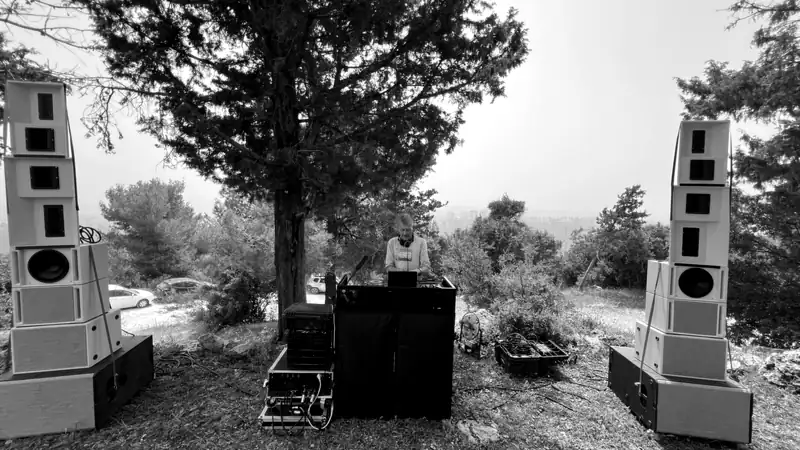
The rig he announced himself, typed at speed with a photograph attached: the ten inch ANGEL WINGS, and his own promise that it will awaken your ears.